
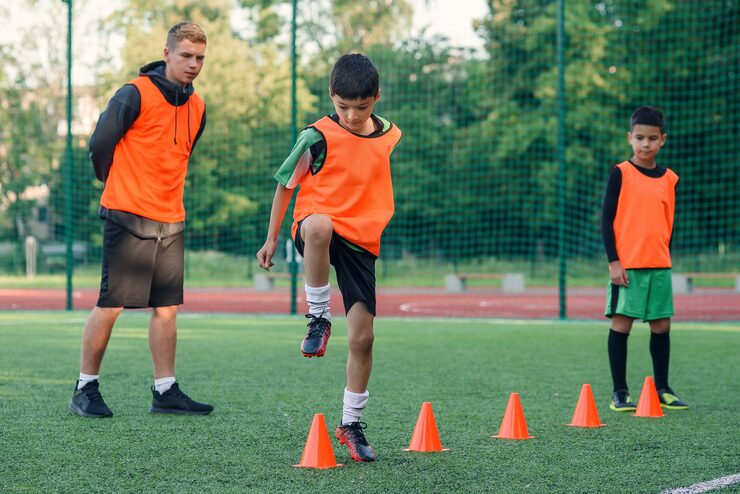
Discipline and focus might not be the first things that come to mind when you think of kids playing football. The image of children chasing a ball across the field in a blur of laughter and limbs often paints a picture of unstructured chaos. But beneath the surface, childrens football training is a powerful and intentional environment for teaching self-control, concentration, and goal-directed behaviour. And the best part? It all happens through play.
Whether it’s learning to wait your turn in a drill, listening to a coach’s instruction, or staying engaged during a practice match, football naturally encourages the development of focus and discipline—essential skills that benefit children far beyond the field.
1. Why Discipline and Focus Matter in Child Development
Before diving into the football specifics, it helps to understand why these qualities are so important. Discipline and focus are the foundation for:
- Academic success: staying on task, completing assignments, and resisting distractions
- Emotional regulation: managing frustration, delaying gratification, and coping with setbacks
- Social skills: listening to others, cooperating in groups, and following shared rules
- Physical safety: staying aware of surroundings and following instructions in potentially risky environments
In the context of sports, these skills are not only practiced—they are required. A well-run childrens football club becomes a microcosm of life: full of challenges, instructions, rewards, and consequences that gently shape a child’s capacity to focus and behave responsibly.
2. Structure as a Tool for Discipline
Football training is never just a chaotic runaround. Especially in programmes like those offered by Children Sports League, sessions are built on structure—a predictable routine that helps children thrive.
Each session typically includes:
- Warm-ups: where children gather, listen, and follow movement patterns
- Skill stations or drills: which require taking turns, following directions, and mastering technique
- Small-sided games: encouraging application of rules, teamwork, and strategic thinking
- Cool-down and reflection: offering moments of calm, evaluation, and coach feedback
This sequence teaches children to transition between activities, manage impulses (such as running ahead or grabbing the ball), and listen attentively. Over time, this structure builds a rhythm of self-discipline—an internal understanding of when to act, when to wait, and how to focus.
3. The Role of Rules and Repetition
Discipline is largely about consistency. In football clubs, rules aren’t just imposed—they’re practiced and reinforced continuously. Children learn:
- Not to use their hands (except goalkeepers)
- To wait for the whistle before starting a drill
- To respect the referee or coach’s decision
- To stay within boundaries (both physically and behaviourally)
- To play fairly and with sportsmanship
Because these rules are repeated in every session, children internalise them. What begins as external discipline—doing it because the coach says so—eventually becomes self-discipline: doing it because “that’s how we play football.”
Repetition also sharpens focus. Dribbling drills, passing sequences, and movement patterns demand attention. Children learn that improvement comes from tuning in, concentrating, and giving full effort. This develops what psychologists call “task persistence”—the ability to stay engaged even when something is hard.
4. Learning Through Drills and Activities
A good childrens football training session is filled with fun, engaging activities that teach focus and discipline without the child even realising it. Here’s how:
a) Ball Control Exercises
These require fine motor focus, timing, and coordination. Children need to concentrate on their feet, the ball, their posture, and sometimes a moving target. This kind of mindful movement boosts body awareness and attentional control.
b) Passing Drills
Passing isn’t random—it demands accuracy, timing, and communication. Children learn to pause, read the situation, and deliver the ball at the right moment. They focus on their teammates, the ball’s movement, and the coach’s cues.
c) Defensive Positioning
Staying in position is harder than it sounds for a child. It teaches delayed gratification: don’t chase the ball, hold your spot. This instils both patience and a broader understanding of strategy, encouraging the child to think before acting.
d) Tactical Games
Even simple games like 3v3 or 4v4 require kids to apply learned skills in real time. To do this well, they must focus on multiple cues—space, teammates, opponents, instructions—and adjust quickly. This sharpens flexible thinking and fast focus-switching.
5. Coach Influence: Modeling Focus and Reinforcing Discipline
Coaches are critical role models in shaping discipline. At Children Sports League, experienced and DBS-checked coaches use a combination of clear communication, positive reinforcement, and consistency to guide behaviour.
What this looks like in action:
- Giving step-by-step instructions and checking for understanding
- Offering praise for listening, effort, and concentration
- Using consistent consequences for disruptive behaviour (e.g., sit out for a minute, try again)
- Modeling calm focus and respectful tone—children mirror adult behaviours
- Encouraging children to self-correct: “What can you do differently next time?”
The presence of a trusted adult who both expects and believes in a child’s ability to focus makes a powerful difference in behaviour.
6. Developing Internal Motivation
A critical transition in discipline is the move from external control (doing it because someone is watching) to internal motivation (doing it because it feels right or rewarding). Football fosters this shift beautifully.
Children begin to see that:
- Staying focused helps them succeed in drills
- Being disciplined makes the game more fun for everyone
- They can set small goals and meet them by trying hard
- Mistakes are okay, but improvement comes through effort
Through this, children become more self-directed. They start managing their own behaviour—not for a sticker or applause, but because they take pride in their growth. This is one of the most powerful life lessons sport can teach.
7. Handling Setbacks and Building Resilience
Focus and discipline aren’t about being perfect. In fact, learning to handle failure constructively is one of the biggest benefits of sports.
In a football club, children will:
- Miss goals
- Lose possession
- Get subbed out
- Receive feedback
- Occasionally be on the losing side
What matters is how these moments are framed. Supportive coaches guide children to:
- Reflect rather than sulk: “What can I learn?”
- Reset quickly: “Shake it off, next play.”
- Stay focused even when disappointed
- View mistakes as steps toward improvement
This develops emotional discipline—the ability to stay composed, calm, and committed. Over time, children bring this mindset into school, social situations, and other challenges.
8. The Role of Parents in Supporting Discipline and Focus
While coaches lead training, parents play a big role in reinforcing these values at home. You can support your child’s development by:
- Maintaining routines: getting ready for training, being punctual, setting expectations
- Encouraging responsibility: letting them pack their kit, carry their bag
- Modelling focus: putting away your phone and showing interest during matches
- Celebrating effort over outcomes: “I saw how hard you tried to stay in position!”
- Giving space to reflect: ask what they learned rather than what they won
When children see that football isn’t just about results, but about who they are becoming, they start to value discipline and focus in deeper ways.
9. Football Clubs and the Bigger Picture
A well-run childrens football club is more than just a weekly activity. It’s a community that nurtures essential life skills.
The structure, repetition, and guidance provided during training sessions create an ideal space for learning discipline—not through punishment, but through participation. Focus isn’t forced; it’s fostered.
Clubs like Children Sports League take this to the next level by:
- Designing sessions based on child development science
- Mixing individual challenges with teamwork tasks
- Offering consistent routines that children can grow within
- Providing coaches who understand the balance between fun and focus
- Supporting progress from playful beginners to more tactical pre-teens
Whether your child joins a group session, a private tennis session to enhance focus, or participates in a birthday party with mini-games, the benefits are constant: structured fun that nurtures the habits of discipline.
10. A Sport That Shapes the Mind as Much as the Body
In the end, football training for children isn’t just about learning to pass or shoot. It’s about shaping habits—paying attention, trying again, showing up, working with others, following instructions, and giving your best. These are the building blocks of a focused, disciplined individual.
Through the seemingly simple acts of listening to a coach, staying on your line, or passing at the right time, children internalise lessons that stick. Not because someone told them to—but because football taught them how.