
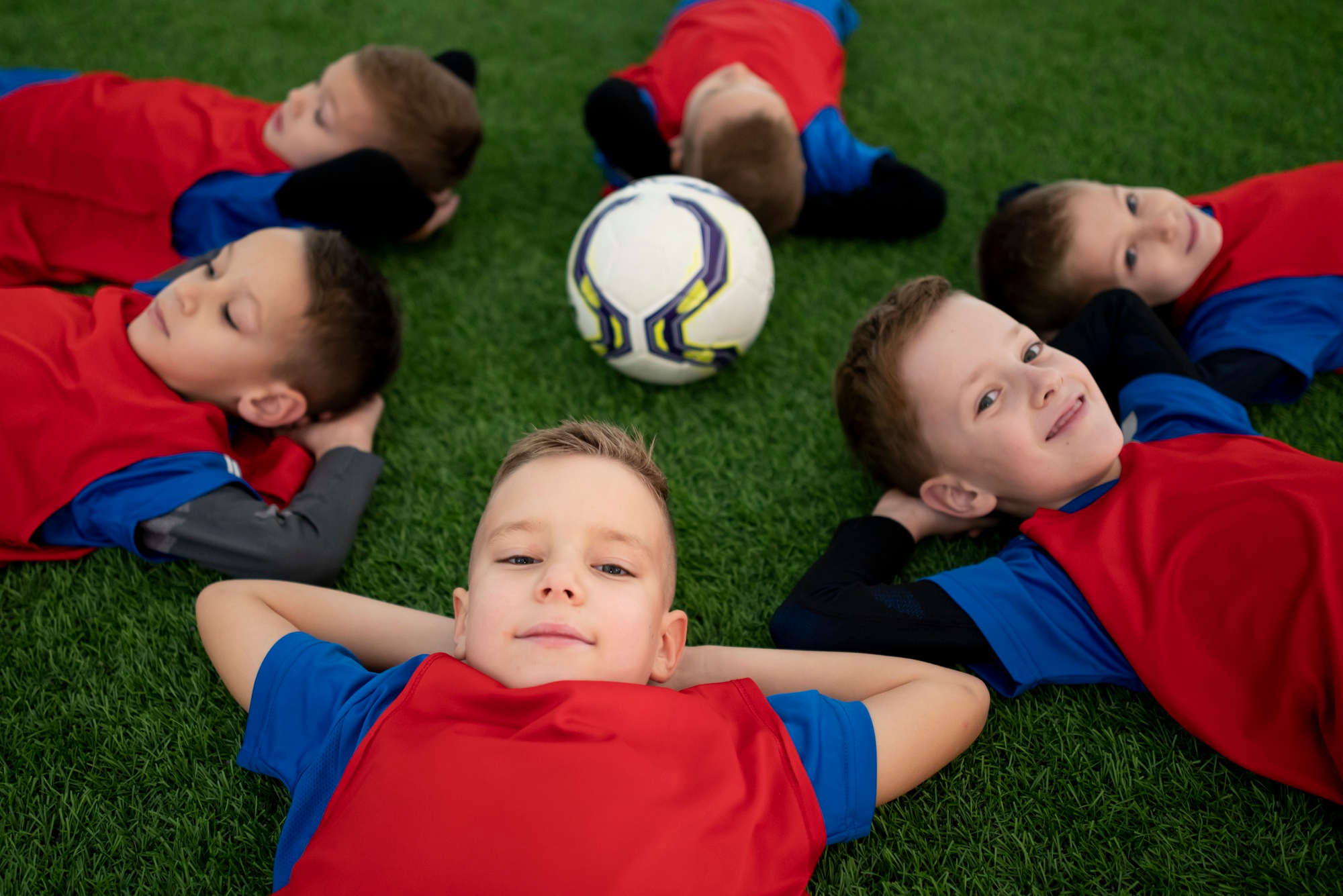
A football session for a three-year-old should look very different from one designed for a ten-year-old. The younger child may spend much of the session pretending cones are volcanoes, chasing a ball through an imaginary jungle and celebrating simply because they managed to kick it towards a goal. The older player might be thinking about passing combinations, positioning, defending and how to make better decisions during a match.
Both children are learning football. They are simply learning it in ways that suit different stages of development.
Effective Childrens football training changes as children grow because their physical abilities, concentration, communication, confidence and understanding of the game are constantly developing. Activities that capture the imagination of a toddler may feel too simple for a pre-teen, while tactical instructions suitable for an older child would overwhelm a beginner who is still discovering how to stop a moving ball.
Understanding these changes helps explain why children’s football is about much more than making exercises gradually harder. The entire learning environment evolves with the players.
The Earliest Sessions Are Often About Movement
For very young children, football begins with their bodies rather than with tactics.
Running, stopping, jumping, balancing and changing direction are important foundations for almost every sport. Young children are still developing these fundamental movement skills, so early Football training often combines football with general physical play.
A child might run between cones, jump over a line or chase a rolling ball.
These activities may appear simple, but they provide valuable opportunities to develop coordination and body awareness.
At this stage, the objective is not necessarily to create perfect football technique.
Children are learning what happens when they move quickly, slow down, turn around or kick something with their foot.
Football provides an exciting reason to explore those movements.
Imagination Plays a Major Role for Toddlers
Tell a three-year-old to practise dribbling around six cones and their attention may disappear quickly.
Tell them that the cones are sleeping dragons they must sneak past with their football, and suddenly the same physical task becomes much more interesting.
Imaginative play can be extremely useful in Childrens football training for younger age groups.
A ball can become treasure.
A goal can become a castle.
The coach might become a friendly monster trying to catch players.
Behind every story, however, there can be a developmental purpose.
Children may be practising close ball control, changing direction or moving through space while believing they are simply playing a game.
As children grow, this imaginative element does not need to disappear completely, but coaching instructions can gradually become more directly connected to football.
Younger Children Need Simple Instructions
The amount of information children can process changes significantly with age.
Young players usually benefit from short, clear instructions followed by an immediate opportunity to move.
Long explanations can quickly become difficult to follow.
Instead of describing every technical detail involved in dribbling, a coach might simply say, “Keep the ball close.”
The children can then experiment.
Demonstrations are also particularly helpful.
Seeing the activity often makes much more sense than hearing a long description of it.
As players become older and more experienced, coaches can gradually introduce additional details.
A simple instruction about passing might eventually expand into discussions about where to place the supporting foot, how much power to use and where to move after releasing the ball.
The information grows with the player’s ability to understand and apply it.
Ball Familiarity Comes Before Advanced Technique
One of the earliest goals in Football training is simply helping children become comfortable with the ball.
Young beginners often kick it much harder than necessary and then spend several seconds chasing it.
They may try to stop the ball and accidentally step over it.
A turn might result in the child changing direction while the football remains behind.
These are normal stages of learning.
With repeated experience, children begin to understand how the ball responds to different touches.
They discover that a gentle touch keeps it nearby.
They learn that using different parts of the foot changes direction.
Over time, coaches can introduce increasingly technical challenges.
What began as simply moving with a ball might later include specific turns, controlled first touches and dribbling under pressure.
Games Gradually Become More Structured
Very young children’s football can look wonderfully chaotic.
Several children may chase the same ball together.
Positions barely exist.
Everyone wants to score.
That chaos contains plenty of learning.
Children are discovering how the game works.
As they grow, however, activities within Childrens football training can gradually become more structured.
Small-sided games may begin introducing simple ideas such as attacking one goal and defending another.
Players start noticing that spreading out can create more space.
Later, they may learn that moving without the ball can be just as important as moving with it.
The game begins to make more sense as a collection of relationships rather than simply a race towards the football.
Passing Becomes Increasingly Important
For very young players, possession can feel extremely valuable.
Once they finally get the football, the last thing they want to do is give it to someone else.
This is perfectly understandable.
Dribbling provides immediate enjoyment.
As children become more socially and tactically aware, passing starts to make greater sense.
They notice teammates.
They understand that someone else may be in a better position.
A coach can then introduce activities that reward cooperation.
During Football training, older children might work on passing in pairs, moving after the pass or combining several passes to reach a target.
Eventually, they begin understanding that passing is not simply giving the ball away.
It can be a way of keeping possession and moving the team forward.
Children Become Better at Looking Around
Beginner players often concentrate almost entirely on the football.
Their eyes remain fixed on it because controlling the ball requires so much attention.
As coordination improves, children gain more capacity to notice what is happening around them.
They start seeing teammates.
They notice opponents approaching.
They recognise open spaces.
This increased awareness changes Childrens football training considerably.
Coaches can begin encouraging players to look up before receiving the ball or check where teammates are positioned.
Activities can introduce multiple choices.
Instead of simply dribbling towards one goal, a child might have two possible targets and need to decide which one is available.
Football becomes increasingly connected with observation and decision-making.
Technical Skills Become More Detailed
As children grow and gain experience, coaches can spend more time developing specific football techniques.
Passing can become more accurate.
Receiving the ball can involve different parts of the foot.
Dribbling may include changes of speed and direction.
Shooting can focus on balance and placement as well as power.
The key difference is that technique develops on top of earlier movement foundations.
A child who has spent years running, balancing and interacting with a ball is better prepared to understand more detailed movements.
This progression is one reason age-appropriate Football training matters.
Trying to introduce advanced technique too early can turn a playful activity into something unnecessarily complicated.
The challenge should grow alongside the player.
Older Children Can Handle More Decision-Making
Football is not simply a collection of techniques.
Players need to decide when to use them.
An older child may know how to pass and dribble, but the interesting question becomes which option is appropriate in a particular moment.
Training can therefore become increasingly decision-based.
A coach might create a game where players have several goals to attack.
Defenders can be introduced.
Passing options may change continuously.
The player has to observe, decide and act.
This creates a more realistic form of learning because actual matches are unpredictable.
Within Football clubs, older children can gradually learn that the same skill may produce different results depending on when and where it is used.
Team Roles Begin to Make More Sense
Ask a very young player where they want to play and there is a good chance the answer will be somewhere near the opposing goal.
Scoring is easy to understand.
Defending can initially seem less exciting.
As children grow, they become capable of understanding different team roles.
They start learning why defenders need to protect space.
They discover how midfield players can connect different areas of the pitch.
Goalkeepers develop their own specialist skills.
Young players do not necessarily need to be permanently assigned one position too early.
Experiencing different roles can actually broaden their understanding of the game.
A child who tries defending may better understand what makes life difficult for a defender when they later play as an attacker.
Communication Becomes More Sophisticated
Early football communication can be extremely simple.
“Pass!”
“Here!”
“My ball!”
These short calls represent an important starting point.
As children become older, communication can become more purposeful.
Players may tell teammates where there is space.
A defender might warn another player about an opponent.
Someone receiving the ball may hear a teammate calling instructions.
Group Football training provides frequent opportunities for this communication to develop naturally.
Children begin to understand that talking can help the entire team function more effectively.
They also become more capable of listening while moving, which is an important skill in a fast-changing game.
Competition May Become More Meaningful
Very young children often enjoy competition in simple forms.
Who can knock down a cone?
Who can dribble through all the gates?
Who can score into the tiny goal?
As children grow, matches and scores may become more significant to them.
Competition can create excitement and motivation, but it needs to remain balanced with development.
A child’s value within Football clubs should not depend entirely on whether their team wins.
Older players still need room to experiment and make mistakes.
If every mistake is treated as disastrous because the score matters more than learning, players may become afraid to try new things.
Healthy competition gives children challenges while allowing development to remain central.
Physical Differences Become More Noticeable
Children do not grow at exactly the same rate.
As they move towards later childhood, differences in height, speed, strength and coordination may become increasingly visible.
One player may suddenly become much taller.
Another may develop speed earlier.
Someone else might remain smaller but possess excellent balance or decision-making skills.
Good Childrens football training recognises these differences without assuming that the most physically developed child is automatically the most talented.
Physical advantages can change considerably as children grow.
Coaches can therefore continue valuing technique, awareness, teamwork, creativity and effort alongside speed and strength.
This creates opportunities for different types of players to develop confidence.
Children Become More Capable of Reflecting
A toddler is unlikely to spend much time analysing why a particular pass did not work.
They simply chase the ball and continue playing.
Older children become increasingly capable of reflection.
A coach can ask questions such as, “Where was the space?” or “What could you try next time?”
Instead of immediately providing the answer, the coach can encourage the player to think.
This changes the nature of Football training.
Children become active participants in understanding the game rather than simply following instructions.
They can begin explaining what they noticed and why they made a particular decision.
That ability to reflect can help develop more independent players.
Friendships Often Become More Important
The social experience of football also changes with age.
A very young child may primarily focus on the activity and coach.
As children spend more time within Football clubs, friendships can become an increasingly important part of why they enjoy attending.
They know who they want to warm up with.
They have favourite passing partners.
They remember funny moments from previous sessions.
Football becomes connected to belonging.
These relationships can also influence learning.
Children challenge one another, encourage one another and celebrate achievements together.
For some players, seeing friends at football becomes just as important as the football itself.
Training Can Become More Game-Like
As children’s skills and understanding develop, training activities can increasingly resemble real football situations.
Instead of practising a pass without opposition, players might need to complete it while a defender applies pressure.
Dribbling can involve choosing whether to take on an opponent or pass to a teammate.
Shooting might happen after a combination of movements rather than from a stationary position.
This progression helps children connect individual skills with the game.
A technique is no longer something they perform because the coach instructed them to.
It becomes a tool for solving a football problem.
Fun Changes Rather Than Disappears
One common misconception is that training needs to become increasingly serious as children grow.
The activities certainly become more sophisticated, but enjoyment remains important.
What children find fun simply changes.
A toddler may love pretending to escape from sharks while dribbling.
An eight-year-old might enjoy a competitive shooting challenge.
A pre-teen may find excitement in a fast small-sided match where they need to solve tactical problems.
Age-appropriate Childrens football training evolves without losing the playful element that makes children want to participate.
The games become more complex, the decisions become faster and the technical expectations increase, but curiosity and enjoyment can remain at the centre of learning.
The child who once celebrated simply because their foot connected with the ball may eventually begin thinking about where to pass before they even receive it. Between those two moments are years of running, experimenting, listening, laughing, competing and discovering new challenges.
That gradual change is what makes children’s football development so interesting. The game grows with the player, becoming more detailed and demanding while continuing to offer new ways to move, think, cooperate and enjoy being on the pitch.