
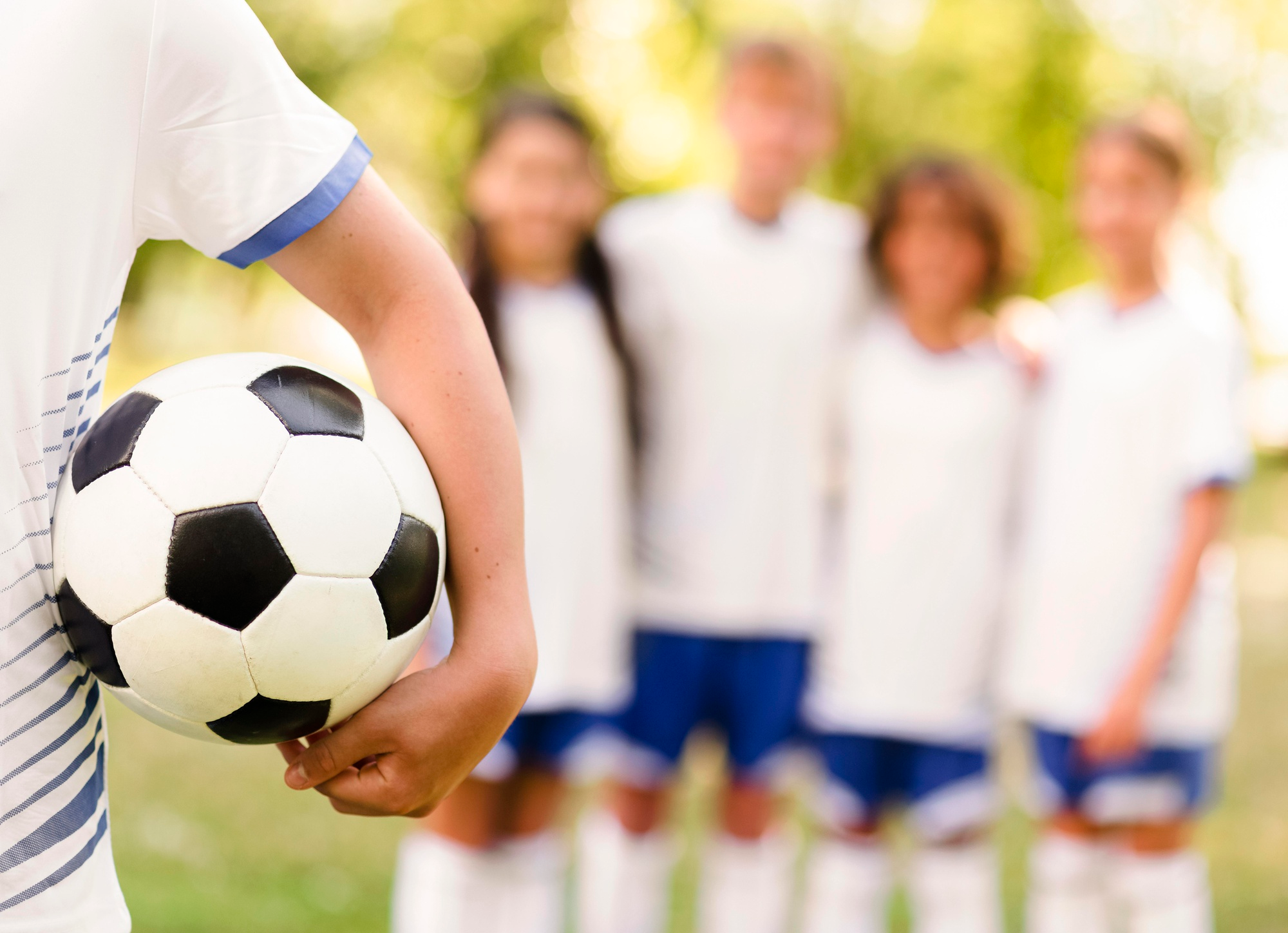
Children learn with their whole bodies.
They learn when they climb, chase, balance, throw, kick, catch, jump and fall. They learn when they invent rules for a game, negotiate with friends, solve a movement problem or discover that something difficult becomes easier after several attempts.
Active childhood experiences can therefore be about much more than exercise.
A session at a Childrens football club, a playful Tennis session, an afternoon in the park or an energetic game in the garden can all give children opportunities to explore movement, relationships and decision-making.
For adults, it is sometimes tempting to separate learning and play. Learning happens in the classroom, while play happens afterwards.
For children, however, those boundaries are often much less clear.
Play can involve concentration, creativity, communication, memory, problem-solving and persistence—all while the child is moving.
Movement Helps Children Understand Their Bodies
Young children are constantly discovering what their bodies can do.
Can they jump over that line?
How quickly can they stop after running?
Can they balance on one foot?
What happens if they kick the ball gently instead of powerfully?
These small experiments help children develop body awareness.
Sport provides endless opportunities for this kind of exploration.
During Childrens football training, a child may run while controlling a ball, change direction around another player and suddenly stop before reaching a cone.
In tennis, they may move sideways, judge a bounce and swing a racket while staying balanced.
Every activity creates a different physical problem.
The child has to find a solution through movement.
Play Makes Repetition More Interesting
Children need repetition to learn physical skills.
A single attempt at kicking, catching or balancing is rarely enough.
The challenge for adults is making that repetition interesting.
This is where play becomes useful.
Imagine asking a young child to dribble a football from one side of a field to another ten times.
The movement may become repetitive very quickly.
Now imagine turning the same task into a game where the child is transporting treasure while avoiding imaginary sharks.
The technical movement is repeated, but the experience feels completely different.
Good Football training frequently uses games for this reason.
Children may repeat the same underlying skill dozens of times without feeling that they are performing the same exercise.
Active Games Encourage Problem-Solving
Sport continually presents children with small problems.
A defender is blocking the path.
Where should the player move?
A tennis ball bounces further away than expected.
How can the child reach it?
There is only one open space between several players.
Can they find it?
These situations require decisions.
Young children may respond instinctively at first.
With experience, they begin recognising patterns.
During Childrens football training, for example, a player may discover that running directly towards a defender does not always work.
Next time, they try changing direction.
If that works, they have learned something through experience rather than through a long explanation.
This kind of problem-solving is one reason games can be such powerful learning environments.
Children Learn Through Immediate Feedback
Physical play provides unusually clear feedback.
Kick a football too hard and it travels too far.
Swing a tennis racket too early and the ball may be missed.
Run too quickly into a turn and balance becomes difficult.
Children can see the result of their actions immediately.
That feedback encourages adjustment.
They try again.
Perhaps the next kick is softer.
The next swing is later.
The next turn is more controlled.
A Tennis session may contain hundreds of these little experiments.
Not every one requires a coach to explain what happened.
Sometimes the result itself teaches the child.
Adults can support the process by offering simple guidance while still allowing children space to experiment.
Social Learning Happens While Children Play
Active experiences are rarely only physical.
Place several children together with a ball and social learning begins almost immediately.
Who goes first?
Who has possession?
What happens if two children want the same role?
How do they organise teams?
How do they respond when someone makes a mistake?
These situations create opportunities to practise communication and cooperation.
Within a Childrens football club, children may learn to call for a pass, listen to teammates and congratulate another player.
They also encounter disagreements.
Two players might believe a ball went out in different places.
Someone may feel frustrated because a teammate did not pass.
With appropriate support, children can gradually learn how to manage these everyday social situations.
Team Games Introduce Shared Goals
Many childhood activities focus on individual achievement.
Football creates a different challenge because success often depends on other people.
A child can be an excellent dribbler, but eventually they may need to pass.
They can score goals, but someone else may have created the opportunity.
Team games encourage children to recognise that other people’s actions matter.
During Football training, coaches can create challenges where several players need to cooperate.
Perhaps everyone must touch the ball before a goal can be scored.
Maybe pairs have to move the football through a series of gates.
The football skill is important, but so is the cooperation happening around it.
Children begin learning that working together can solve problems that would be difficult alone.
Individual Sports Offer Another Kind of Learning
Team activities are valuable, but individual sports create different experiences.
Tennis often places more responsibility directly on the player.
Once the ball crosses the net, the child has to respond.
They decide where to move, how to position the racket and where to send the next shot.
A Private tennis session can make this especially noticeable because the child receives continuous opportunities to make decisions and respond independently.
There is no teammate who can solve the next ball for them.
This independence can support confidence and concentration.
At the same time, group tennis lessons can combine that individual responsibility with social interaction.
Children can rally with partners, take turns and participate in shared challenges.
Sport Can Help Children Become Comfortable With Mistakes
Mistakes are unavoidable in physical activity.
Balls go in the wrong direction.
Children trip.
Shots miss.
Instructions are misunderstood.
From a learning perspective, this is useful.
Children discover that mistakes do not necessarily end an activity.
They can try again.
A player might miss three shots and score the fourth.
A difficult movement can become easier after repeated attempts.
Supportive Childrens football training can help children experience mistakes as part of improvement rather than something embarrassing.
This attitude can become valuable far beyond the sports field.
Many parts of childhood involve learning things that initially feel difficult.
Sport gives children a very visible example of how practice changes ability.
Success Can Be Small and Still Matter
Adults often notice the obvious sporting achievements.
A goal.
A winning point.
A successful match.
Children may value completely different moments.
A young player might be delighted because they stopped the football with one foot for the first time.
Someone else may proudly complete a rally of three shots during a Tennis session.
Another child may feel successful simply because they joined a group activity without needing encouragement.
These achievements matter because they are personal.
Progress does not always need to be compared between children.
A skill that feels easy to one child may require considerable courage or concentration from another.
Recognising individual improvement allows more children to experience the satisfaction of learning.
Active Play Supports Creativity
Movement is often surprisingly creative.
Give children a football, some cones and open space, and they may invent a completely new game.
A goal becomes a castle.
A marked area becomes an island.
Rules change halfway through because someone has a new idea.
This creativity is not separate from learning.
Children are designing problems, testing rules and adapting activities.
Coaches can encourage this by occasionally allowing players to make choices.
During Football training, children might invent their own dribbling challenge or choose a movement everyone else has to copy.
A tennis coach might let players design a target game.
These moments give children ownership over the activity.
Different Environments Create Different Challenges
A football pitch, tennis court, playground and garden all encourage different types of movement.
This variety can be valuable.
Football often involves larger spaces, continuous running and interaction with multiple players.
A Tennis session may require more precise movement within marked boundaries.
Playground activities may involve climbing and jumping.
Informal games can change rules constantly.
Children adapt to each environment.
They learn to judge distances, understand boundaries and modify their movements according to the space available.
Experiencing different activities helps build a broad movement vocabulary.
Physical Confidence Can Encourage Participation
Children who become more comfortable with movement may be more willing to join active games.
A child who feels confident running, balancing and controlling a ball may approach a new activity with curiosity rather than hesitation.
This confidence develops through experience.
The more opportunities children have to move in supportive environments, the more familiar physical challenges can become.
A Childrens football club can provide one setting where these experiences happen regularly.
The aim does not need to be producing highly advanced players.
Simply becoming comfortable moving within a group can be meaningful progress.
Coaches Can Turn Learning Into Exploration
The way adults present activities has a major influence on how children experience them.
A coach can describe exactly what a child must do, or create a challenge that encourages them to discover a solution.
For example, rather than explaining how to avoid a defender in great technical detail, a football coach might ask, “Can you find a way past?”
Now the child experiments.
They may move left.
That fails.
Next time they change speed.
That works.
This approach can make Childrens football training feel more exploratory.
The coach remains available to guide the child, but learning becomes something the player participates in rather than something simply delivered to them.
Concentration Can Develop Through Movement
Adults sometimes imagine concentration as sitting quietly.
Sport demonstrates another kind of focus.
A child chasing a ball may be intensely concentrated.
They are watching its direction, monitoring other players and preparing their next movement.
During tennis, attention may narrow towards the ball and its bounce.
During football, it may spread across several teammates and opponents.
These activities require children to maintain and shift attention while moving.
Because the task is active, children may remain focused on something longer than they would during a passive exercise.
Rules Help Children Understand Boundaries
Games need rules.
Even very simple ones create structure.
Stay inside the cones.
Wait for the signal.
Do not use your hands.
Take turns.
Stop when the coach calls.
For young children, learning to participate within these boundaries is itself valuable.
They discover that games work because people share expectations.
As children grow, the rules can become more complex.
Within Football clubs, they gradually learn concepts such as fouls, restarts and positions.
In tennis, they learn court boundaries and scoring.
Understanding and following these rules develops alongside the physical skills.
Free Play Still Has an Important Role
Structured coaching can offer children useful guidance, but not every active experience needs an adult directing it.
Free play gives children a different type of learning.
When adults step back, children decide what the game is.
They create rules.
They negotiate disagreements.
They decide when something should change.
A simple football game in the park may have jumpers for goalposts and rules invented five minutes earlier.
That does not make it meaningless.
In fact, those informal experiences can encourage creativity and independence.
Organised Football training and spontaneous play can complement each other rather than compete.
One provides structure and coaching.
The other provides freedom.
Movement Can Connect Different Areas of Development
It is difficult to separate physical, social and emotional development during active play because they often happen simultaneously.
Imagine a child attempting to dribble past another player.
Physically, they are controlling the ball and changing direction.
Mentally, they are deciding which way to move.
Emotionally, they may be managing nervousness about losing possession.
Socially, they are interacting with another person.
One brief moment contains several types of learning.
The same can happen during a Private tennis session when a child attempts a difficult shot, or during group tennis when two players try to maintain a rally together.
Sport creates situations where different developmental areas naturally overlap.
The Best Learning Experiences Often Feel Like Play
Children do not need every activity explained in terms of development.
They do not need to know that a game is improving spatial awareness, coordination or decision-making.
They can simply enjoy it.
Adults can understand the learning happening underneath while children experience something much simpler: movement, curiosity and fun.
A child running towards a football is not analysing motor development.
They want to reach the ball.
A young tennis player trying to knock over a cone is not thinking about hand-eye coordination.
They want to hit the target.
That difference is part of what makes active learning so effective.
Whether children are enjoying Childrens football training, experimenting during a Tennis session, learning individually in a Private tennis session, or simply inventing a new game with friends, active experiences give them countless opportunities to test ideas, understand their bodies, interact with others and discover what happens when they keep trying something that once seemed difficult.