
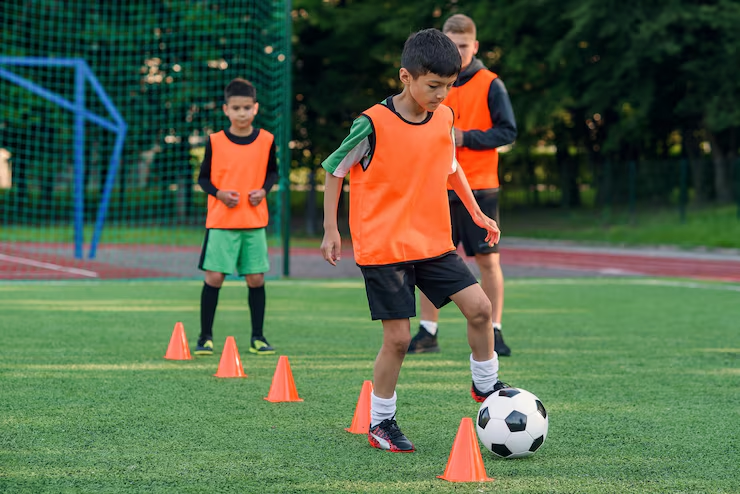
When children engage in structured sports like football, the benefits go far beyond simply learning how to pass, dribble or shoot. In particular, childrens football training offers a powerful vehicle for building confidence — emotional, social and physical — in young players. In the context of a programme such as Children Sports League, where football classes are designed by physical‑education professionals and delivered in a fun, supportive environment, the effects can be particularly strong.
Below we explore why football training helps boost confidence, how the mechanisms work, and what parents and coaches can do to maximise the benefits for children.
1. Why Football Training Builds Confidence
a) Evidence from research
There is growing scientific evidence that sports participation is strongly linked to improved self‑confidence in children. For example:
- One study of school‑aged children found a strong positive correlation between sports participation and self‑confidence (r = 0.807, p < 0.001). ResearchGate
- Another review concluded that youth who participate in team sports show improved self‐esteem and self‐worth. pce.sandiego.edu
- A study of 13‑14‑year olds found that those engaging in sports had significantly higher “internal” and “external” self‑confidence than their non‑sporting peers. ERIC
b) The unique aspects of football
Football — especially at children’s level — has characteristics that make it particularly conducive to building confidence:
- It’s a team sport, so children experience belonging, cooperation, and shared success (and failure) — this fosters a sense of being part of something.
- It is active and visible: scoring a goal, making a good pass, improving a skill — children can see their progress and receive instant feedback.
- It offers clear milestones and challenges: moving from basic drills to small‑sided games, children can track their improvement, which boosts self‑efficacy.
- It’s fun and social, which reduces the pressure and allows children to explore, fail, try again, and grow in confidence in a supportive setting.
2. How Confidence Grows Through Football Training
Here’s a breakdown of the pathways by which regular, well‑structured football training builds confidence:
a) Mastery of motor skills and physical competence
When children take part in football training sessions, they gradually master fundamental movement skills (running, changing direction, controlling the ball). In the programme by Children Sports League, these skills are delivered in age‑appropriate progressions. As children see that they can do things they couldn’t before, their physical competence grows — which is a key part of self‑confidence. Research shows that improved physical competence links to higher self‐esteem in youth sports. PMC+1
b) Setting and achieving small goals
In a children’s football club environment, training might include drills like “complete five passes in a row” or “score in mini‑goal”. Achieving such micro‐goals gives children immediate feedback: “I did this; I succeeded.” Those wins add up and children begin to believe in their ability. This habit of setting up achievable goals and succeeding is central to building confidence.
c) Positive social interactions and peer support
Being part of a football club means children train alongside peers, make new friends, and experience positive social dynamics. Feeling accepted, cheering each other, and being part of a team helps children feel valued and competent socially. The sense of belonging enhances confidence beyond just the physical domain.
d) Learning to handle setbacks
Football training also includes losing a game in a small‑sided match, missing a pass, or making a mistake. In a well‑run childrens football training environment, these are handled as learning opportunities: coaches encourage reflection (“What can we try differently next time?”) rather than blame. Over time children learn to bounce back from errors, which reinforces resilience and thereby confidence.
e) Coach and mentor influence
The role of the coach is pivotal. At Children Sports League, all coaches are DBS checked and experienced. A coach who provides constructive, positive feedback, emphasises effort over outcome (“Great hustle! Next time we’ll aim to pass sooner”), fosters a growth mindset. According to youth‑sports research, supportive coaching is strongly linked to increased athletic self‑belief. Psychology Today
3. Age‑Appropriate Confidence Development in Football Training
Different age groups will experience confidence growth differently. In the context of Children Sports League’s offering (toddlers to pre‑teens), here’s how it typically unfolds:
For toddlers (approx. 2‑4 years)
- Sessions focus on basic movement, coordination, fun games with balls — less “football tactics”, more exploration.
- Confidence at this age comes from simply being able to participate, run, kick and enjoy.
- The social element of being among other children also matters: “I can go to training, I can do the games.”
For younger children (5‑7 years)
- Introduce simple ball skills (dribble, pass) and small‑group games.
- Here children begin to compare their own progress (“I can do this now”) which boosts confidence.
- Coaches can emphasise “look how far you’ve come” moments.
For older children/pre‑teens (8‑12 years)
- More structured training drills, small‑sided games, maybe inter‑club friendly play.
- At this stage children are more aware of peer comparison, so the right environment is key: emphasise improvement, effort, and supportive teamwork.
- Mistakes and setbacks are more noticeable — but framed as normal and part of learning.
- Confidence becomes less about “can I pass the ball?” and more about “can I contribute to the team?”, “can I lead or support others?”
4. Practical Tips for Parents & Coaches to Boost Confidence in Football Training
To ensure the football training truly helps build confidence, here are some actionable tips:
For coaches
- Celebrate small wins: highlight when a child completes a drill better than before, even if they didn’t “win”.
- Use positive language: focus on effort, persistence, improvement (“You kept going even when it was hard”) rather than solely final outcomes.
- Create a safe learning environment: let children make mistakes without fear of criticism; everyone misses passes or misreads a play.
- Foster peer support: encourage team‑mates to congratulate each other, share what they learned, and help each other.
- Set age‑appropriate goals: at each stage identify objectives that are within reach but still challenging — this way children can succeed and see their own growth.
- Involve children in reflection: ask them “What did you do well today? What will you try next time?” This builds self‑awareness and confidence in their own progress.
For parents
- Be a supporter not a critic: focus on your child’s enjoyment, effort and growth rather than only “winning”.
- Reinforce the journey: ask your child about something they improved at, or enjoyed doing — this helps them internalise progress.
- Encourage consistency: regular attendance and repetition build competence, and competence builds confidence.
- Avoid over‑pressure: if the child begins to see the training only as about winning or being perfect, the confidence‑building benefit may diminish.
- Celebrate effort outside of results: “I liked how you asked for feedback from the coach” or “You tried a new move today” are valuable recognitions.
5. The Role of a Children’s Football Club in Confidence Building
Joining a club environment for childrens football training (such as provided by Children Sports League) brings extra confidence‑boosting advantages:
- Structured environment with professional coaches ensures the activities are developmentally appropriate and safe.
- Group dynamics: being part of “the club” gives children a sense of belonging, identity and community.
- Progression and milestones: as children move through age groups or drills, they can see tangible advancement, which strengthens self‑belief.
- Private and small‑group options: for some children, a private tennis session or parallel sport may help build confidence which they then apply in a football club setting. While our focus is football, the mix of sports can support overall confidence in movement and sport‑based tasks.
- Birthday‑party or social events: many clubs run extra events where children participate in informal games and fun. These also reinforce social skills and positive self‑image outside purely performance‑based settings.