
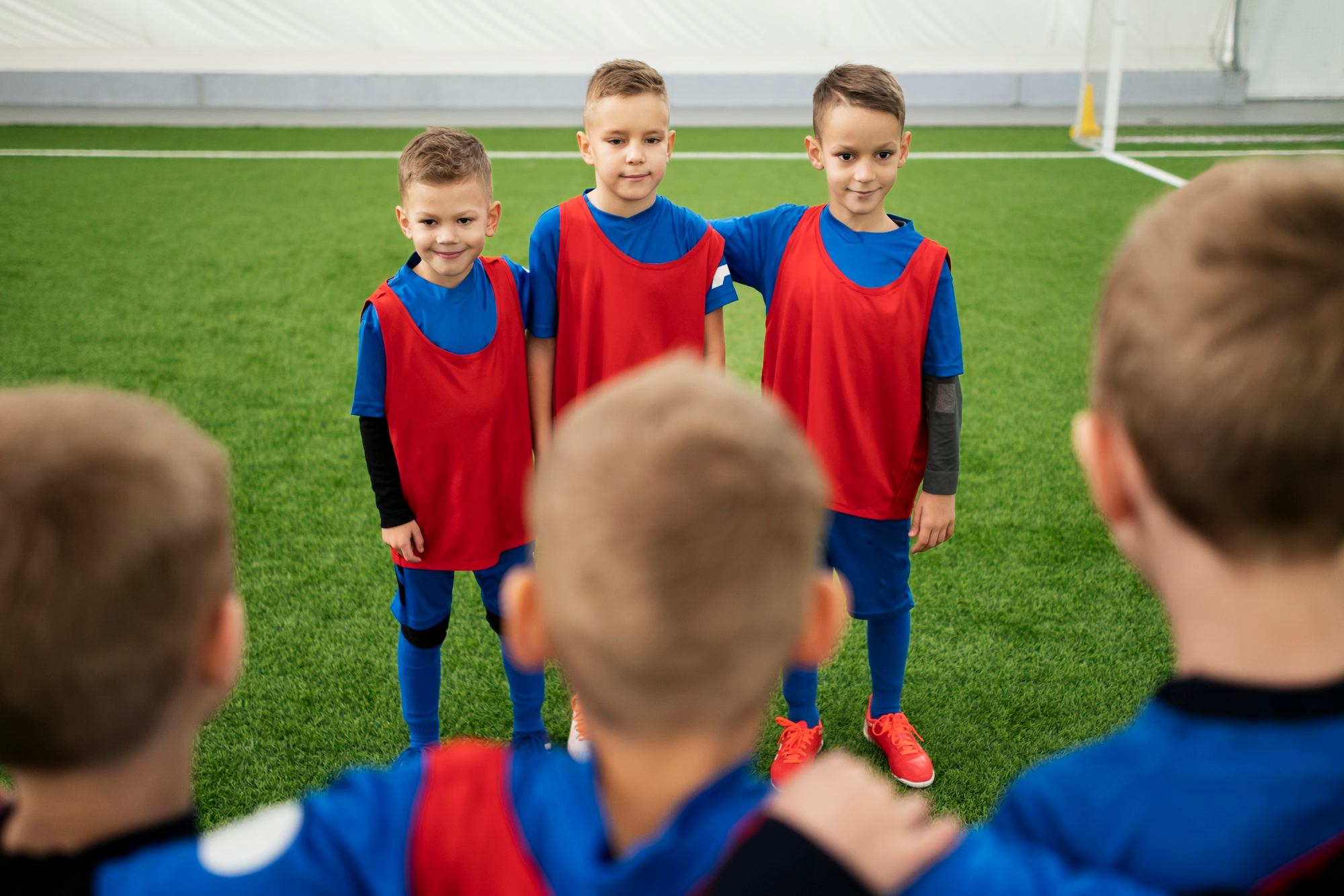
For children, some of the best learning happens when they do not realise they are practising at all. A simple game involving a football, a few cones and an imaginative challenge can keep a child moving while developing balance, coordination, agility and ball control at the same time.
This is one of the reasons play is such an important part of Childrens football training. Young players do not necessarily need complicated drills or lengthy technical explanations. They need opportunities to experiment with movement, repeat skills and discover different ways of controlling their bodies and the ball.
Football naturally brings many movements together. Children run, stop, turn, balance, kick, chase and change direction, often within the space of a few seconds. When these movements are incorporated into enjoyable games, children can practise important motor skills while remaining focused on the excitement of the activity.
A football session might therefore look like a collection of games from a child’s perspective, even though each activity has been carefully designed to encourage particular types of development.
Why Coordination Matters in Children’s Football
Kicking a football may look simple to an adult, but it requires several things to happen at once.
A child must look at the ball, decide where they want it to go, position their body correctly, balance on one leg and move the other leg with an appropriate amount of force.
That is a considerable amount of coordination.
Dribbling creates an even bigger challenge. Children must move while controlling the ball, observe what is happening around them and adjust their speed and direction.
These abilities develop gradually.
During Football training, repeated opportunities to perform different movements can help children become more comfortable coordinating their eyes, feet and body.
The aim does not need to be perfect technique from the beginning. Instead, children can explore how different movements work and gradually gain greater control.
Games make that repetition far more entertaining.
1. Traffic Lights
Traffic Lights is a simple game that works particularly well with younger players.
Each child has a football and moves around a marked area.
The coach calls different colours that represent different actions.
Green means dribble.
Red means stop the ball.
Yellow might mean move slowly.
Additional colours can introduce new challenges. Blue could mean turn around, while purple might ask players to place one foot on top of the ball.
The simplicity of the game hides how much is happening.
Children have to listen, process information and then coordinate their movements in response.
They practise starting, stopping and changing speed while keeping the football under control.
For beginners at a Childrens football club, Traffic Lights can also help children become comfortable moving with their own ball without the pressure of competing against another player.
As players improve, coaches can make the game more challenging by calling colours more quickly or introducing additional movements.
2. The Cone Maze
A collection of cones can quickly become a football obstacle course.
Instead of arranging them in a perfectly straight line, coaches can create a winding maze with different spaces between the cones.
Children then try to guide their football through the course without touching the obstacles.
This activity encourages close control.
A child who kicks the ball too hard may send it beyond the next cone. Someone who moves too slowly may need to find a more efficient way of controlling it.
The challenge naturally encourages players to adjust the strength and direction of their touches.
During Childrens football training, maze activities can also introduce children to using different parts of their feet.
They might use the inside of one foot to move the ball in one direction and the outside to change direction again.
The maze can become more complicated as children gain confidence.
3. Treasure Hunt Football
A football pitch can easily become an imaginary treasure island.
Place coloured cones, beanbags or other safe objects around the playing area. Children dribble their football around the space and collect one piece of “treasure” at a time before returning it to their base.
Suddenly, dribbling practice becomes an adventure.
Children need to navigate around other players, control their football as they approach the treasure and change direction to return to their starting point.
This develops spatial awareness as well as coordination.
They need to observe both the football and the environment around them.
For younger players, imaginative activities like this can make Football training far more engaging than simply being instructed to dribble repeatedly from one cone to another.
4. Follow the Leader
Follow the Leader is another activity where simple movements can create plenty of learning opportunities.
A coach or child becomes the leader while everyone else follows with a football.
The leader may move quickly, slowly, sideways or in a circle.
They might stop the ball, change direction or perform a simple turn.
Everyone else tries to copy.
The game encourages observation and body control.
Children must watch what someone else is doing while continuing to manage their own football.
It can also encourage creativity when children are given opportunities to become the leader.
A player may invent a movement that nobody expected.
Within a Childrens football club, giving children moments where they can lead an activity can also help build confidence.
5. Sharks and Minnows
Chasing games have been popular with children for generations, and adding footballs can create an excellent coordination challenge.
In Sharks and Minnows, most children are the minnows. Each has a football and tries to dribble safely from one side of the area to the other.
One or two children are sharks who try to win or touch the footballs.
The minnows must decide how quickly to move, when to change direction and where there is open space.
This creates a more unpredictable environment than practising around stationary cones.
Children have to respond to moving players.
Those reactions are important in Football training because real games constantly require players to adapt their movements according to what other people are doing.
The activity also creates plenty of laughter, especially when a shark suddenly changes direction and everyone tries to escape at once.
6. Gates Dribbling
This game uses pairs of cones placed around an area to create small gates.
Children dribble through as many gates as possible.
There are no fixed routes.
Instead, each player decides where to go next.
That freedom encourages children to look around rather than concentrating only on the ball.
They must identify an available gate, move towards it and control the ball accurately enough to pass between the cones.
More experienced children can be challenged to use both feet or perform a turn after passing through each gate.
This is a useful example of how Childrens football training can combine physical and cognitive skills.
Children are not simply moving. They are making decisions while moving.
7. Football Statues
Football Statues combines ball control with balance.
Children dribble freely until the coach gives a signal.
Everyone must immediately stop their football and become a statue.
The coach might introduce different types of statues.
Children could balance with one foot gently resting on top of the football. They might stand on one leg or create their own funny pose while keeping the ball still.
Balancing helps children develop body awareness and stability.
The challenge becomes even more interesting because they have just been moving.
They need to transition from running or dribbling into a controlled stationary position.
For young children attending Football clubs, playful games such as Football Statues can make fundamental movement practice feel completely natural.
8. Knock Down the Castle
Children often love activities where there is an obvious target.
In Knock Down the Castle, cones become towers or castles that players try to knock over by passing or shooting a football towards them.
The challenge encourages accuracy.
Children have to judge the distance between themselves and the target and decide how strongly to kick the ball.
A huge kick is not necessarily the best option.
If the target is nearby, a controlled pass might be more successful.
This helps children understand that different situations require different amounts of force.
During Football training, target games can provide immediate feedback. If the ball misses to the left, the child can adjust their next attempt.
The falling cone also provides a satisfying reward when they succeed.
9. Dribble and Freeze
Dribble and Freeze is simple enough for very young players but can be adapted for older groups.
Children move around with their football while music plays or while the coach gives a continuous signal.
When the sound stops, everyone freezes and stops their football as quickly as possible.
This helps children practise reacting to external information while controlling movement.
Stopping a moving football requires timing and coordination.
Players gradually learn how to bring the ball under control without sending it several metres away.
Variations can make the activity more interesting. When children freeze, the coach might ask them to touch the ball with a knee, sit beside it or switch to using the opposite foot when movement begins again.
10. Colour Corners
Mark four corners of the playing area with different coloured cones.
Children dribble around the middle until the coach calls a colour.
They then have to identify the correct corner and move towards it while controlling their football.
This apparently simple activity combines listening, visual recognition, decision-making and movement.
Players also need to avoid bumping into each other as several children head towards the same area.
A coach can make the game more challenging by giving clues instead of calling colours directly.
For example, “Go to the colour of grass” or “Find the colour of a strawberry.”
These small additions introduce imagination and problem-solving into Childrens football training.
11. Passing Through the Gates
Motor development does not need to focus only on individual movement.
Passing games allow children to coordinate their actions with another person.
Two players stand on opposite sides of a small gate made from cones and try to pass the ball through it to each other.
At first, the gate can be quite wide.
As accuracy improves, the cones can gradually move closer together.
Children learn to judge how much power they need and where they should place their supporting foot when passing.
Receiving the ball creates a different challenge.
They have to watch it approach and attempt to control it before making the next pass.
These repeated exchanges help develop timing, coordination and concentration while introducing cooperation.
12. Clean Your Room
Despite the name, this game is usually much more popular than household cleaning.
Divide a playing area into two halves and split the children into two teams. Several footballs are placed on each side.
When the game begins, players kick footballs into the other team’s half.
When time runs out, everyone stops and the footballs are counted.
The activity creates plenty of movement because children are constantly searching for footballs, positioning themselves and kicking them into the opposite area.
It also encourages awareness.
Children have to notice which footballs are available and avoid colliding with teammates.
Within a Childrens football club, games like this can introduce team-based activities without requiring children to understand complicated rules or positions.
Making Games Appropriate for Different Ages
The same activity can often work for several age groups when the difficulty is adjusted.
A toddler might simply dribble through large gates.
An older child could complete the same activity while using only their weaker foot or performing a turn after every gate.
The important factor is creating a challenge that is achievable without becoming too easy.
If an activity is far beyond a child’s current ability, frustration can quickly replace enjoyment.
If it is too simple, attention may disappear.
Experienced coaches can observe how children respond and adapt Football training accordingly.
The playing area might become larger or smaller. Defenders might be introduced. Players might receive additional challenges.
Small adjustments can completely change the difficulty of a game.
Repetition Does Not Have to Feel Repetitive
Developing motor skills requires repetition.
Children need many opportunities to kick, stop, turn and move with a football.
However, repeating exactly the same drill over and over is not the only way to achieve this.
A child might practise dribbling during Traffic Lights, Treasure Hunt, Sharks and Minnows and Colour Corners.
The football skill is repeated, but the challenge changes.
In one game they are responding to instructions. In another they are avoiding opponents. Somewhere else they are searching for a particular destination.
This variety can keep Childrens football training interesting while still providing the repetition necessary for development.
Allowing Children to Experiment
There is not always one correct way for young children to solve a movement challenge.
One player may dribble around an obstacle with the inside of their foot. Another may naturally use the outside.
Someone might take several small touches while another prefers slightly larger ones.
Children benefit from opportunities to experiment before receiving too many instructions.
Playful Football training gives them space to discover what happens when they move faster, kick harder or change direction differently.
Coaches can then introduce guidance at appropriate moments.
This balance between structured instruction and free exploration can help children develop both technical skills and confidence in their own movements.
When the Game Becomes the Teacher
Some of the most effective children’s football activities require surprisingly little explanation.
Create an interesting problem and children will often begin searching for solutions themselves.
Put defenders in the middle and they learn to change direction.
Create a narrow gate and they begin trying to pass accurately.
Give them several targets and they start looking around before moving.
Ask them to protect a football and they begin experimenting with body positioning.
A well-designed game can therefore become a teaching tool.
The coach still provides support, encouragement and guidance, but children are actively discovering how movement works rather than simply copying instructions.
For young players, that combination of imagination, activity and exploration can transform Childrens football training into something that feels less like practice and much more like the kind of play they naturally want to return to week after week.